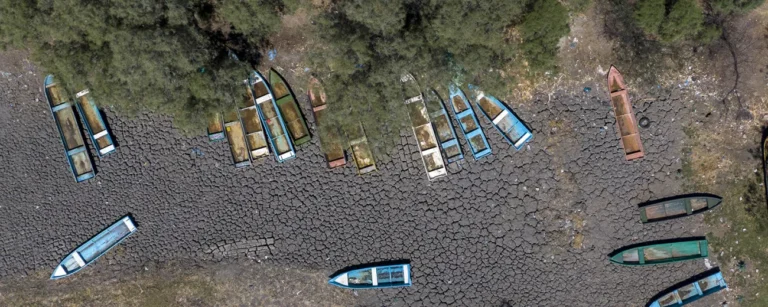
The latest report from the World Meteorological Organization points to below normal flows across more than a third of the world’s river basins, and to a continuing, decade-long decline in the fresh water stored on land – in groundwater, lakes, soils, snow and ice – which acts as a buffer during dry years.
Drying rivers are a sign of things to come. The frequency, severity, and duration of droughts are projected to increase due to climate change, impacting livelihoods and contributing to displacement.
For this year’s International Disaster Risk Reduction Day on October 13, the theme is “Resilience Starts at Home”. Severe droughts put an enormous strain on households’ water security, and also on the water needed for agricultural productivity and to support livelihoods. Resilience in the face of severe drought requires anticipation and planning not only at the household level, but also at the community, national and international levels.
Here we look at the impacts of drought, and what can be done to reduce the risks it poses.
Impacts of drought
As the climate warms, higher temperatures increase evaporative demand, drawing more moisture out of soils, vegetation, rivers, lakes and wetlands. When heat coincides with low rainfall, droughts can develop faster and become more intense – sometimes within weeks, leading to so-called “flash droughts”.
The consequences have a human face; they include crop failure and livestock losses leading to hunger and food insecurity for affected communities, especially women and girls who are responsible for household water security in many parts of the world. Droughts also contribute to degraded ecosystems, and a higher likelihood of sandstorms, dust storms and wildfires – all of which worsen air quality. Without rain, river and lake levels fall, and people often turn to unsustainable groundwater use to keep their businesses and farms afloat.
According to the International Drought Resilience Alliance, launched at the UNFCCC COP27 in November 2022, drought caused around $124 billion in economic losses between 1998 and 2017. More recent estimates put the cost much higher, at $307 billion a year – and even these figures are likely too low, as indirect and cascading impacts are hard to measure and do not capture the toll in human suffering.
Putting water at the heart of climate adaptation
To cope with longer lasting droughts that are expected with climate change, we will need to both reduce global warming and manage water in innovative ways.
To reach Net Zero we need ambitious mitigation to reduce CO₂, nitrous oxide and methane emissions. But we also need to develop adaptation measures that take into account projected climate change impacts.
Adaptation “must become transformational and responsive to evolving non-linear and abruptly arising risks,” according to UNEPs Limiting Overshoot Spotlight Report. In other words, we need to avoid adaptation interventions (maladaptations) that could be overtaken by climate events.
Here are some examples of context-specific adaptation, preparedness and restoration measures designed to combat drought from around the world:
- In Sri Lanka, tank cascade systems – interconnected networks of reservoirs that capture, store and redistribute rainwater for irrigation, human use and ecosystem support – have been used for 2,000 years to help alleviate drought.
- In South Africa’s Eastern Cape, the planting of spekboom(Portulacaria afra) – a shrub or small tree that experts consider key to reviving vast areas extensively degraded by overgrazing, invasive species and drought – is making both ecosystems and communities more resilient in the face of climate pressures.
- In Niger, farmers have deployed a traditional technique to recover degraded land and prevent desertification by digging crescent-shaped ditches. Also called “zai pits” or “half-moons,” these ditches capture scarce rainwater and direct it towards growing plants. Another proven method called “assisted natural regeneration” involves fencing in trees and other vegetation to protect them from grazing animals and woodcutters, allowing them to regenerate.
- In Iraq, UNEP is working with partners on a constructed wetlandpilot project, offering a practical, sustainable solution for cleaning polluted water and restoring dry wetlands.
UNEP’s role in building resilience
The United Nations Environment Programme (UNEP) cares about drought resilience in both urban and rural settings and encourages sustainable use and management of precious water resources.
Through the United Nations System‑wide Strategy for Water and Sanitation, UNEP supports aligning sustainable water and sanitation goals with climate adaptation and mitigation, biodiversity conservation, pollution prevention and disaster risk reduction.
“Fresh water is increasingly recognized as a connector and foundational environmental system that underpins climate stability, ecosystem integrity, pollution pathways, human wellbeing and sustainable economic development, yet institutional responsibilities remain fragmented,” says Deputy Director of UNEP’s Ecosystems Division Doreen Lynn Robinson. “This means we need system-level engagement at global, regional and country levels.”
Working with partners to strengthen the resilience of freshwater ecosystems is an important part of UNEP’s work. Built for Drought Resilience: Proposing a global Drought Resilience Capacity Indexoutlines a methodology developed by UNEP for measuring and monitoring drought resilience worldwide.
At the country level, these efforts are also being translated into action on the ground. Along with the European Commission, UNEP is leading a watershed project called “Sustainable protection and restoration of rivers, wetlands, and lakes through integrated, sustainable watershed management planning in Brazil and India”. It seeks to build on established integrated water resource management approaches, focusing on watershed management at the basin level in order to improve people’s lives.
In Brazil’s Alto Araguaia Basin, the project is strengthening participatory water governance and watershed planning, alongside practical soil and water conservation measures. In India’s Ramganga Basin, ongoing implementation is helping to prioritize tributary and wetland restoration interventions. Experience across both countries is helping to identify sustainable finance pathways to support long-term implementation. Together, projects in these countries will generate practical lessons to inform replicable and scalable watershed management approaches elsewhere.
A UNEP-hosted platform called the Baku Dialogue on Water for Climate Action advances climate-resilient integrated water management. And at the UNCCD COP 17, UNEP led or co-organized 10 events to support cooperation on drought mitigation, adaptation and the restoration of degraded land, including overgrazed rangelands in climate vulnerable, transboundary and conflict-affected settings.
Read more: www.unep.org